
TEXT
Ruth 2:1 — “And Naomi had a kinsman of her husband’s, a mighty man of wealth, of the family of Elimelech; and his name was Boaz.”
Ruth 2:2 — “And Ruth the Moabitess said unto Naomi, Let me now go to the field, and glean ears of corn after him in whose sight I shall find grace. And she said unto her, Go, my daughter.”
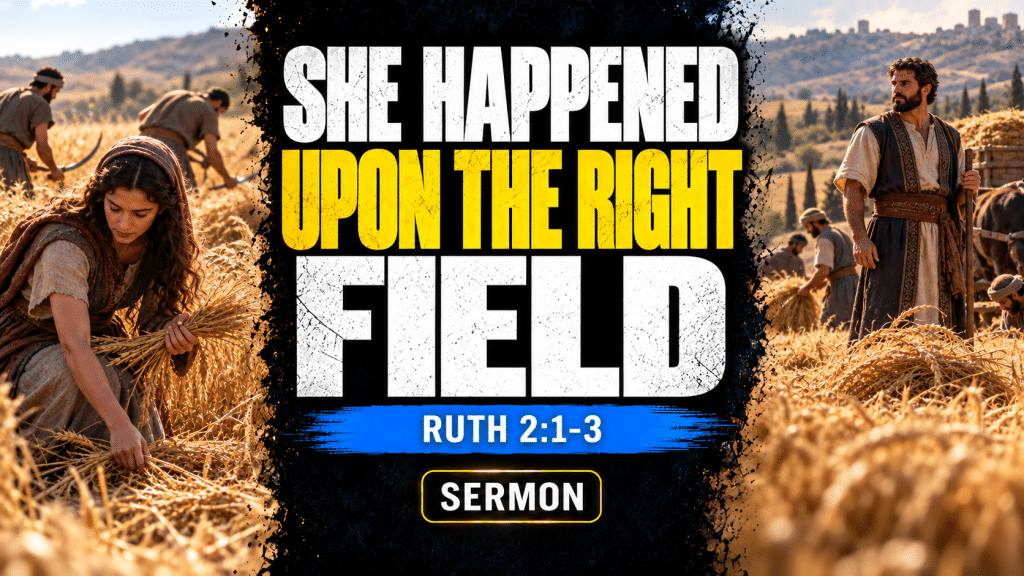
Ruth 2:3 — “And she went, and came, and gleaned in the field after the reapers: and her hap was to light on a part of the field belonging unto Boaz, who was of the kindred of Elimelech.”
INTRODUCTION
Ruth 2:1–3 begins with three ordinary things: a man named Boaz, a widow looking for work, and a field where she can glean. Yet these three verses begin the visible turn from the loss of chapter 1 toward the provision that follows.
Ruth is Book 8 of 66, and Ruth 2 is chapter 2 of 4 in Ruth and chapter 234 of 1,189 in the Bible. The book takes place “in the days when the judges ruled.” Chapter 1 brought famine, death, widowhood, and Naomi’s return to Bethlehem with Ruth. Naomi said that she had come home empty, but the chapter closed with their arrival “in the beginning of barley harvest.” The harvest was already there when they arrived.
Ruth enters chapter 2 knowing that she and Naomi need food. She does not know which field she will enter or where that day will lead. Before Ruth takes her first step, the narrator tells us about a man whose name was Boaz.
I. A MIGHTY MAN OF WEALTH, WHOSE NAME WAS BOAZ — VERSE 1
Ruth 2:1 — “And Naomi had a kinsman of her husband’s, a mighty man of wealth, of the family of Elimelech; and his name was Boaz.”
The verse begins, “And Naomi had.” While Naomi feels the weight of what she has lost, the narrator tells us about someone already connected to her family. Boaz is “a kinsman of her husband’s.” His exact relationship is not given here, and Ruth 3:12 later says another kinsman was nearer. Boaz truly belongs to Elimelech’s family.
He is also called “a mighty man of wealth.” The words present Boaz as a man of substance, resources, and standing. The chapter shows him with land, reapers, servants, and authority over his field.
Then the verse says, “and his name was Boaz.” The narrator gives us his name before Ruth ever enters his field. That order is part of the story. The reader knows there is a man named Boaz, knows he belongs to Elimelech’s family, and knows he has substantial means. Ruth’s words in verse 2 give no indication that she is setting out to find him.
Chapter 1 ended with Naomi saying, “I went out full, and the LORD hath brought me home again empty.” Yet it also ended with barley harvest beginning. Now chapter 2 opens with Boaz already in Bethlehem. Ruth sees the need for food; the reader has already been shown a man who will soon become part of the provision.
Ruth did not need to know everything ahead of her before she could faithfully handle what was in front of her.
II. LET ME NOW GO TO THE FIELD, AND GLEAN — VERSE 2
Ruth 2:2 — “And Ruth the Moabitess said unto Naomi, Let me now go to the field, and glean ears of corn after him in whose sight I shall find grace. And she said unto her, Go, my daughter.”
The narrator again calls her “Ruth the Moabitess.” She has come to Bethlehem with Naomi, but she is still a foreign woman from Moab. She is also a widow with very little. Those facts make her plan to glean fit the very kind of need God had provided for in Israel’s law.
Ruth says, “Let me now go to the field.” The initiative comes from Ruth. She sees useful work she can do and asks Naomi to let her go. Her words are respectful, and her purpose is clear.
She says that she will “glean ears of corn.” In the KJV, “corn” here means grain. They had arrived at the beginning of barley harvest. Gleaning meant following after the main harvesters and gathering what remained.
God had already given Israel a law for this.
Deuteronomy 24:19 — “When thou cuttest down thine harvest in thy field, and hast forgot a sheaf in the field, thou shalt not go again to fetch it: it shall be for the stranger, for the fatherless, and for the widow: that the LORD thy God may bless thee in all the work of thine hands.”
Ruth is both a stranger and a widow. God’s law required the landowner to leave opportunity for people in her condition. The owner left grain, and the needy person gathered it.
The text does not tell us how much of the Mosaic law Ruth already understood. Her proposed work matched the provision God had established, and she was willing to gather what the reapers left.
Ruth adds, “after him in whose sight I shall find grace.” “Grace” here means favor from another person. She is looking for a field where the person in authority will receive her favorably. Later in the chapter, Boaz will command his men not to trouble her and will give her unusual liberty and protection. Ruth enters the field knowing that the character of the people there will matter.
Naomi answers, “Go, my daughter.” The narrator calls her “the Moabitess”; Naomi calls her “my daughter.”
Ruth cannot choose the final outcome of this day, but she can go to the field and work. Faithfulness begins with doing the clear thing that is actually ours to do.
III. HER HAP WAS TO LIGHT ON THE FIELD BELONGING UNTO BOAZ — VERSE 3
Ruth 2:3 — “And she went, and came, and gleaned in the field after the reapers: and her hap was to light on a part of the field belonging unto Boaz, who was of the kindred of Elimelech.”
Verse 2 gave Ruth’s intention. Verse 3 records the action: “she went, and came, and gleaned.” She said that she would go, and she went. She said that she would glean, and she got behind the reapers and worked.
Then the narrator tells us where she ended up: “her hap was to light on a part of the field belonging unto Boaz.”
“Hap” is old English for something that happens or occurs. “To light on” means to come upon or arrive at. The wording presents the field as an unplanned arrival from Ruth’s point of view. She did not announce in verse 2 that she was going to search for Elimelech’s relative. She went looking for a place to glean.
Verse 1 said, “his name was Boaz.” Verse 3 says, “the field belonging unto Boaz.” The two verses meet right here. Ruth knew she had found a field where she could work. She did not yet know what Boaz would become in the story.
The verse closes by repeating that Boaz “was of the kindred of Elimelech.” Ruth has come into the field of a particular man from the family whose losses filled chapter 1.
This is quiet providence. Ruth receives no recorded vision, sign, or voice naming Boaz’s field. Scripture describes her arrival from the human side with the word “hap.” The completed story shows how much that ordinary occurrence came to mean.
Proverbs 16:9 — “A man’s heart deviseth his way: but the LORD directeth his steps.”
Ruth made a real plan: “Let me now go to the field.” She went, came, and gleaned. Yet she could never have arranged Boaz’s relationship to Elimelech, his resources, or the part he would later play in the family.
As the chapter continues, Boaz notices Ruth, protects her, feeds her, and gives her abundant opportunity to glean. Naomi later learns whose field Ruth entered and says that the man is near of kin. Boaz eventually marries Ruth, Obed is born, and the family line continues through Jesse to David and ultimately to Jesus Christ.
None of that was visible when Ruth first bent down behind the reapers. We know the meaning of this event because God gave us the completed story. We do not need to turn every coincidence in our lives into a private message from God. We can do what Ruth did: faithfully handle what belongs to us and trust God with circumstances we cannot arrange.
Ruth could choose to go and work. She could not choose everything that would meet her along the way. Faithfulness was her responsibility; the outcome was beyond her knowledge and control.
CONCLUSION
Ruth walked into the field without knowing the future attached to it. She had enough light to do the next right thing: go, glean, work, and care for the need in front of her. The rest of the story was already larger than anything she could see.
That gives us a steady way to live. We do not need to know every outcome before we obey what God has made clear. We do not need to control every circumstance before we act faithfully. And we do not need to invent secret meanings for every unexpected event in order to trust God’s providence.
Do the work that belongs to you. Be faithful with the responsibility in front of you. Leave tomorrow, the people you will meet, the doors that may open, and the results you cannot command in God’s hands. Ruth went out looking for a place to glean. Her hap was to light on the right field.

Leave a Reply