
Scriptures for Today
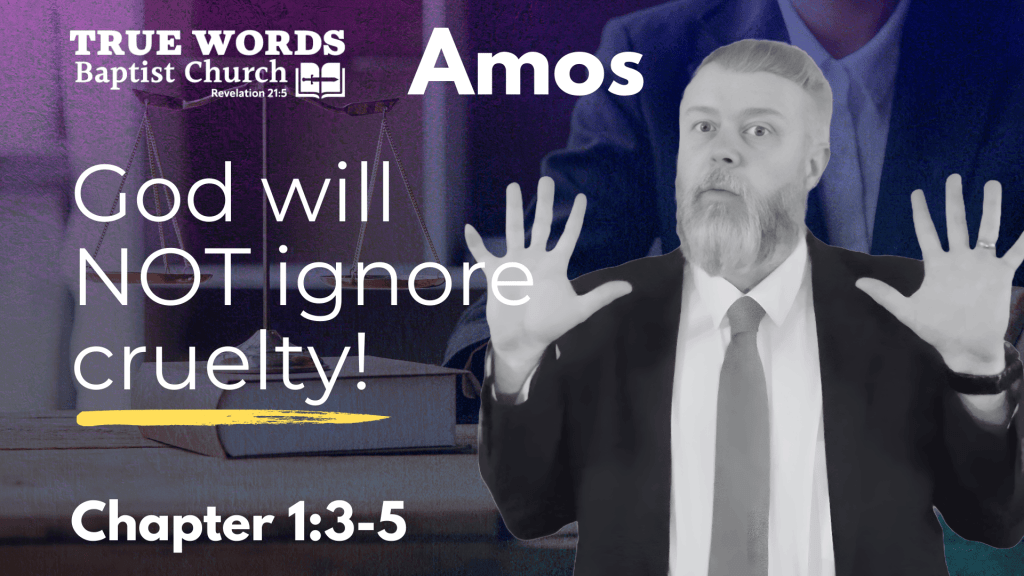
Amos 1:3-5
Thus saith the LORD; For three transgressions of Damascus, and for four, I will not turn away the punishment thereof; because they have threshed Gilead with threshing instruments of iron: 4 But I will send a fire into the house of Hazael, which shall devour the palaces of Ben-hadad. 5 I will break also the bar of Damascus, and cut off the inhabitant from the plain of Aven, and him that holdeth the sceptre from the house of Eden: and the people of Syria shall go into captivity unto Kir, saith the LORD.
Introduction — Amos and the Opening of the Book
The book of Amos takes place during the time of the divided kingdom.
After Solomon died, the nation split into two kingdoms. The northern kingdom was called Israel, and the southern kingdom was called Judah. Amos is preaching during the time when both kingdoms still existed, before the northern kingdom of Israel was destroyed by the Assyrians.
Amos himself was not a professional prophet. He was a working man. The Bible tells us he was a herdman and a gatherer of sycomore fruit. He lived in a town called Tekoa in Judah. But God called him to go north and preach to the kingdom of Israel.
The message Amos brought was a message of judgment. The nation had become wealthy and comfortable, but at the same time they were full of corruption, injustice, and false worship. People were living in sin while pretending everything was fine.
Now before Amos begins listing the nations that God will judge, the book opens with two important verses.
Amos 1:1
The words of Amos, who was among the herdmen of Tekoa, which he saw concerning Israel in the days of Uzziah king of Judah, and in the days of Jeroboam the son of Joash king of Israel, two years before the earthquake.
This verse tells us who Amos was and when he preached.
He was a herdman from Tekoa. That means he was a shepherd. He was not raised among the schools of the prophets. He was not a royal advisor. He was an ordinary man that God chose to deliver a message. God chooses ordinary men.
The verse also gives us the time period. Amos preached during the reign of Uzziah king of Judah and Jeroboam the son of Joash king of Israel. This was a time when Israel was politically strong and rich. On the outside things looked good. But spiritually the nation was corrupt.
People can be that way too. They might look good on the outside but inside they are spiritually corrupt. They can be rich and wealthy but be very corrupt.
The verse also mentions something interesting: “two years before the earthquake.” That earthquake must have been so memorable that people used it as a reference point for time. It shows that Amos was preaching shortly before a major event that people would remember for years. Then the next verse describes how the message begins.
Amos 1:2
And he said, The LORD will roar from Zion, and utter his voice from Jerusalem; and the habitations of the shepherds shall mourn, and the top of Carmel shall wither.
This is powerful imagery. The Bible uses imagery like this often and especially in the prophets. The Bible says “The LORD will roar from Zion.” That picture is like a lion roaring before it attacks. It shows that God is about to act in judgment.
The voice of God is coming from Zion, from Jerusalem, the place where God had placed His name. And the result of that voice will be devastation.
The verse says the habitations of the shepherds shall mourn and the top of Carmel shall wither. Carmel was known for its fertility and vegetation. If even Carmel withers, it means the land itself will feel the effects of God’s judgment.
So before Amos even begins speaking about the nations, he announces something very important. God is about to roar. God is about to speak. And judgment is about to begin. It’s time to listen and it’s time to hear.
Then in verse 3, Amos begins listing the nations that God will judge, starting with Damascus. Let’s look at this closely.
The Pattern of Judgment
Amos 1:3
Thus saith the LORD; For three transgressions of Damascus, and for four, I will not turn away the punishment thereof; because they have threshed Gilead with threshing instruments of iron.
The verse begins with a very strong phrase. “Thus saith the LORD.” This is not Amos giving his opinion. This is God speaking. I always hear the clowns in this world tell me the Bible is written by man. Well, take a look at the Scriptures. God told man what to write. It’s coming, ALL OF IT, from the Lord God Almighty.
After THUS SAITH THE LORD, we see a phrase that appears many times in Amos. “For three transgressions… and for four.” This is a Hebrew way of saying that the sins of this nation have piled up. Sin after sin after sin. Their transgressions have reached the point where God will no longer overlook them. In other words, judgment is now certain.
God says He will not turn away the punishment. Then the specific crime is mentioned. It says they “threshed Gilead with threshing instruments of iron.” Threshing is what farmers did to separate grain from the husk. They used heavy tools to crush and grind the grain.
But here the imagery is violent. Damascus had treated the people of Gilead with extreme cruelty. Many people do that in today’s world and especially in this area. They had crushed them the way someone would crush grain with iron tools.
This is describing brutal warfare and oppression. God saw it. And God says the punishment will not be turned away. When you want to treat someone with cruelty, God is watching.
Now let’s understand Damascus a little better as you see it right there in verse 3. Damascus was the capital city of Syria, and it was one of the main enemies of Israel throughout the Old Testament. Many of Israel’s wars were fought against the Syrians, and their kings ruled from Damascus.
This was not some small village. Damascus was an ancient and powerful city. It is even mentioned in the days of Abraham.
Genesis 15:2
And Abram said, Lord GOD, what wilt thou give me, seeing I go childless, and the steward of my house is this Eliezer of Damascus?
So Damascus had existed for a very long time. It was a strong city, a center of power, and the headquarters of the Syrian kings who repeatedly attacked Israel. When Amos begins with Damascus, the people listening would immediately know what he meant. This was a powerful enemy nation that had treated God’s people with cruelty.
But no matter how strong a city becomes, and no matter how powerful a nation looks, God sees what they do. And God says their punishment will not be turned away.
Judgment on the House of Hazael
Amos 1:4
But I will send a fire into the house of Hazael, which shall devour the palaces of Ben-hadad.
Now God announces the judgment that will come. He says “I will send a fire into the house of Hazael.” In the Bible, fire often represents destruction and judgment. God is a consuming fire the Bible says.
The house of Hazael refers to the ruling power of Syria. Hazael was one of the kings of Syria who had fought against Israel. Then God mentions Ben-hadad, another Syrian ruler. The palaces of their power and wealth will be destroyed.
God begins right there in the Scriptures describing the judgment that will come upon Damascus, and He mentions two very important names in the history of Syria: Hazael and Ben-hadad. These were kings of Syria who repeatedly fought against Israel and caused great suffering to God’s people.
Let’s understand who these men were according to the Scriptures. Hazael first appears in the Bible during the ministry of the prophet Elisha.
2 Kings 8:7-9
And Elisha came to Damascus; and Ben-hadad the king of Syria was sick; and it was told him, saying, The man of God is come hither. 8 And the king said unto Hazael, Take a present in thine hand, and go, meet the man of God, and inquire of the LORD by him, saying, Shall I recover of this disease? 9 So Hazael went to meet him, and took a present with him, even of every good thing of Damascus, forty camels’ burden, and came and stood before him, and said, Thy son Ben-hadad king of Syria hath sent me to thee, saying, Shall I recover of this disease?
At that time Ben-hadad was the king of Syria, and Hazael was his servant and military officer. But something shocking happens next. Elisha reveals that Hazael will become king, and that he will do terrible things to Israel.
2 Kings 8:12
And Hazael said, Why weepeth my lord? And he answered, Because I know the evil that thou wilt do unto the children of Israel: their strong holds wilt thou set on fire, and their young men wilt thou slay with the sword, and wilt dash their children, and rip up their women with child.
Elisha describes the cruelty Hazael would bring. He would burn their strongholds. He would kill their young men. He would destroy their cities. And that prophecy came true. Hazael later murdered Ben-hadad and took the throne of Syria.
2 Kings 8:15
And it came to pass on the morrow, that he took a thick cloth, and dipped it in water, and spread it on his face, so that he died: and Hazael reigned in his stead.
So Hazael became king by assassination. After that, Hazael repeatedly attacked Israel.
2 Kings 10:32
In those days the LORD began to cut Israel short: and Hazael smote them in all the coasts of Israel;
He conquered large portions of the land. He oppressed the people of Israel. And the cruelty of the Syrians became well known.
That is the background behind the statement in Amos 1:3 about threshing Gilead with threshing instruments of iron. It describes the brutal warfare Syria brought against the people east of the Jordan River. So when Amos says God will send fire into the house of Hazael, he is talking about the dynasty and power of Syria.
The verse also says the fire will devour the palaces of Ben-hadad. Ben-hadad was not just one king. That name was used by multiple Syrian rulers, almost like a royal title. These kings ruled from Damascus and built powerful palaces and strongholds. But God says those palaces will not stand forever.
The power of Syria looked strong at the time. Their kings ruled with military power. Their armies conquered cities. But God declares that their kingdom will fall.
The same houses that once oppressed Israel will be consumed. Because no kingdom, no palace, and no ruler can stand against the judgment of the Lord.
The Breaking of Damascus
Amos 1:5
I will break also the bar of Damascus, and cut off the inhabitant from the plain of Aven, and him that holdeth the sceptre from the house of Eden: and the people of Syria shall go into captivity unto Kir, saith the LORD.
The bar of Damascus refers to the defensive strength of the city. Ancient cities had gates and bars that protected them. When God says He will break the bar, it means the city will lose its protection. GOD WILL BREAK IT.
The inhabitants will be cut off. The rulers who hold the sceptre will be removed. And finally the people of Syria will go into captivity. This is a complete collapse of the nation. The city will fall. The rulers will fall. The people will be taken away.
And the verse ends again with the phrase: “saith the LORD.” This judgment is certain because it comes from God Himself.
Now let’s understand the places mentioned in this verse because God is being very specific about what He is going to destroy. He gives the exact names of the places.
First the verse mentions “the plain of Aven.” The word Aven means vanity, wickedness, or idolatry. Many believe this refers to a region in Syria that was connected with idol worship. In other words, it was a place known for false religion and corruption. God says the inhabitants of that place will be cut off. Salt Lake City, Utah home of the Mormons is a great comparison to Aven.
Then the verse mentions “the house of Eden.” This is not the Garden of Eden from Genesis. This was a royal region or district in Syria where rulers lived. When the Bible says “him that holdeth the sceptre from the house of Eden,” it is talking about the kings or rulers of Syria. God is saying their leadership will be removed.
The verse also mentions Syria itself. Syria was the nation whose capital was Damascus. Throughout the Old Testament, Syria repeatedly fought against Israel and caused great suffering to the people of God. Damascus was the center of that power.
Finally the verse says “the people of Syria shall go into captivity unto Kir.” Kir was a region far away to the northeast where the Syrians would eventually be taken as captives. The Bible even mentions Kir in another place when talking about the origins of the Syrians.
Amos 9:7
Have not I brought up Israel out of the land of Egypt? and the Philistines from Caphtor, and the Syrians from Kir?
So the place they originally came from becomes the place they are sent back to as captives. God is describing a complete judgment. The city will fall. The rulers will fall. The people will be taken away.
From the plains… to the palaces… to the entire nation… God says all of it will collapse.
Practical Applications
1. God Sees the Sin of Nations. Damascus thought their cruelty would go unnoticed, but God saw it. No nation escapes the eyes of God.
2. Power Cannot Stop God’s Judgment. Damascus was a strong city, but God said He would break its defenses. When God judges, strength cannot save.
3. Cruelty Matters to God. They threshed Gilead with instruments of iron. God sees how people treat others, and He does not ignore injustice.
4. God Judges the Whole World. God is not only the judge of Israel. He is the judge of every nation on earth.
Conclusion: For Three Transgressions of Damascus
Amos begins his prophecy with judgment on foreign nations. Damascus had acted with cruelty and violence. And God declares that their power, their rulers, and their city would fall. This reminds us of a simple truth. No nation is beyond God’s authority. No kingdom escapes His judgment. And when sin reaches its full measure, judgment comes. Because the Lord is the judge of all the earth.
Let’s pray.

Leave a Reply